产品详情
产品名称GSTM1 Polyclonal Antibody
来源种属Rabbit
克隆性Polyclonal
亚型IgG
纯化Affinity purification
应用WB,IF
种属反应性Human;Mouse;Rat
免疫原描述Recombinant fusion protein of human GSTM1 (NP_666533.1).
标记Unconjugated
别名GST1, GSTM1-1, GSTM1a-1a, GSTM1b-1b, GTH4, GTM1, H-B, MU, MU-1
数据库入口号Swiss-Prot#:P09488
NCBI Gene ID:2944
Uniprot
P09488
计算分子量26kDa
配方Avoid freeze / thaw cycles.|Buffer: PBS with 50% glycerol, pH7.4.
保存Store at -20˚C
应用详情
WB 1:500 - 1:2000
IF 1:50 - 1:100
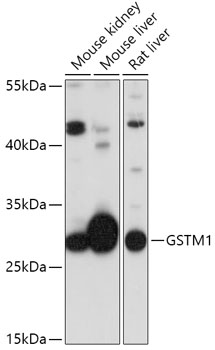
Western blot analysis of extracts of various cell lines, using GSTM1 antibody.
Cytosolic and membrane-bound forms of glutathione S-transferase are encoded by two distinct supergene families. At present, eight distinct classes of the soluble cytoplasmic mammalian glutathione S-transferases have been identified: alpha, kappa, mu, omega, pi, sigma, theta and zeta. This gene encodes a glutathione S-transferase that belongs to the mu class. The mu class of enzymes functions in the detoxification of electrophilic compounds, including carcinogens, therapeutic drugs, environmental toxins and products of oxidative stress, by conjugation with glutathione. The genes encoding the mu class of enzymes are organized in a gene cluster on chromosome 1p13.3 and are known to be highly polymorphic. These genetic variations can change an individual's susceptibility to carcinogens and toxins as well as affect the toxicity and efficacy of certain drugs. Null mutations of this class mu gene have been linked with an increase in a number of cancers, likely due to an increased susceptibility to environmental toxins and carcinogens. Multiple protein isoforms are encoded by transcript variants of this gene. [provided by RefSeq, Jul 2008]
如果您使用该产品30053发表了文章,请通知我们,让我们可以引用您的文献。
et al,Anticancer, Anti‐Inflammatory, and Acute Toxicological Evaluation of the Novel Berberine Derivative BN‐7
, (2025),
PMID:
41417275



 Yes
Yes