产品详情
产品名称Angiotensin II Type 2 Receptor Rabbit mAb
克隆号SN71-03
来源种属Recombinant Rabbit
克隆性 Monoclonal antibody
纯化ProA affinity purified
应用WB, IP
种属反应性Human;Mouse;Rat
免疫原描述recombinant protein
标记Unconjugated
别名AGTR 2 antibody Agtr2 antibody AGTR2_HUMAN antibody angiotensin II receptor type 2 antibody Angiotensin II type-2 receptor antibody Angiotensin receptor 2 antibody AT 2 antibody AT2 antibody ATGR 2 antibody ATGR2 antibody MRX 88 antibody MRX88 antibody Type 2 angiotensin II receptor antibody Type-2 angiotensin II receptor antibody
数据库入口号Swiss-Prot#:P50052
Uniprot
P50052
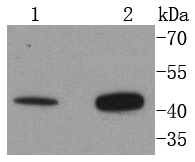
计算分子量41 kDa
配方1*TBS (pH7.4), 1%BSA, 40%Glycerol. Preservative: 0.05% Sodium Azide.
保存Store at -20˚C
应用详情
WB: 1:1,000-1:2,000
Angiotensin II (Ang II) is an important physiological effector of blood pressure and volume regulation through vasoconstriction, aldosterone release, sodium uptake and thirst stimulation. Although Ang II interacts with two types of cell surface receptors, AT1 and AT2, most of the major cardiovascular effects seem to be mediated through AT1. Molecular cloning of the AT1 protein has shown it to be a member of the G protein-associated seven transmembrane protein receptor family. Ang II treatment of cells results in activation of several signal transduction pathways as evidenced by tyrosine phosphorylation of several proteins and induction of others. PLCγ is phosphorylated after 30 seconds of treatment with Angiotensin II, indicating this as an early signal transduction event. Ang II treatment also stimulates phosphorylation of Shc, FAK and MAP kinases, and induces MKP-1, indicating stimulation of growth factor pathways. Ang II stimulation through AT1 has been shown to activate the JAK/Stat pathway involving a direct interaction between JAK2 and AT1 as demonstrated by coimmunoprecipitation. The AT1 receptor has no cytoplasmic kinase domain, but is able to function as a substrate for Src kinases and has several putative phosphorylation sites.
如果您使用该产品49054发表了文章,请通知我们,让我们可以引用您的文献。
et al,LncRNA ZFAS1 Combined with SRSF1 Regulate CNPY2 Expression and Leads to Microglia Endoplasmic Reticulum Stress–Induced Spinal Cord Injury
, (2025),
PMID:
40465066



 Yes
Yes